While I was rinsing outdoor furniture, I suddenly felt someone behind me. I turned and saw my sturdy two-year-old son gripping a bottle of 409 with both hands and the nozzle at his mouth. The shock and fear hit me all at once.
As a member of the Bronner family, I should have been more careful. That near-miss forced a shift in how I approached cleaning products. When I called Poison Control they couldn’t tell me the ingredients in 409— ingredient disclosure wasn’t mandatory back then and is still required in only a few places. Their advice to “watch him and go to the ER if problems arise” left me unsettled and started my search for safer cleaning options.
After that incident, I prioritized cleaners that work effectively with minimal intensity, use ingredients I understand, leave no harmful fumes or residues, and would be unlikely to cause injury if used by a curious child. I didn’t know where the change would lead, but I discovered other benefits: lower cost, less clutter, and fewer single-purpose bottles cluttering the cabinet. A small set of versatile ingredients handled nearly every household task—and often for less money than conventional products. For the comparisons below I used the least expensive big-box brands where possible or the lowest-cost name brands when store brands weren’t available.
With four simple ingredients—Dr. Bronner’s Pure-Castile Liquid Soap and Sal Suds Biodegradable Cleaner, baking soda, and distilled white vinegar—I clean my entire home, even with kids, pets, and wildlife bringing messes through the door daily. Below are examples of how these basics perform and what they replace.
Dr. Bronner’s Castile Magic Soap
Don’t underestimate soap. A pure, well-made soap without fillers, foaming agents, or synthetic fragrances can clean gently and thoroughly. Dr. Bronner’s Castile Magic Soap is formulated primarily for skin health, but its concentrated, residue-free formula works across the house—from counters and floors to walls and laundry. Because it’s concentrated, a single bottle dilutes into many uses, making it economically competitive with conventional and “natural” cleaners. Diluting also reduces plastic waste and shopping trips. Consider refill programs, gallon sizes for refilling smaller bottles, or even the bar soap for plastic-free use. See dilution guides for exact recipes and uses.
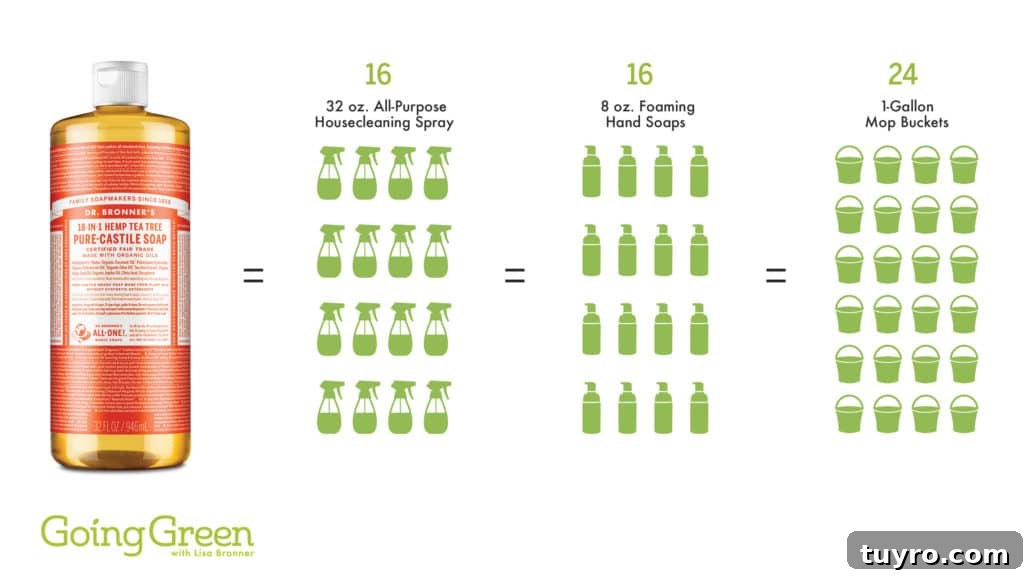
Dr. Bronner’s Liquid Pure-Castile Magic Soap (32 oz.) MSRP*: $18.49 USD
Makes 16 bottles of 32 oz. (1 L) all-purpose housecleaning spray
- Use ¼ cup (60 mL) soap per 1 quart (1 L) water
- $1.16 per spray bottle
- Compared to about $1.97 for a store-brand 32 oz. conventional cleaning spray
Makes 16 bottles of 8 oz. (240 mL) foaming hand soap
- Use 1 part soap to 3 parts water
- $1.16 per foaming-pump refill
- Compared to about $1.47 for a store-brand 8 oz. foaming hand soap
- Peppermint and eucalyptus varieties are best for ages 3 and up; those essential oils may be too strong for younger children.
Makes 24 buckets of 1-gallon mopping solution
- Use 3 tablespoons (45 mL) soap per gallon (4 L) water
- Approximately $0.77 per gallon bucket
- Compared to about $0.44 per gallon for a conventional floor cleaner (prices vary)
Dr. Bronner’s Sal Suds Biodegradable Cleaner
Sal Suds, developed by my father in the 1980s, is a tougher cleaner formulated to handle stains and hard water while rinsing clean and remaining biodegradable. If Castile Soap is the versatile daily cleaner, Sal Suds is the heavy-duty tool for tougher jobs. It’s more concentrated than Castile, so you use less per dilution and get more uses per bottle, which boosts savings alongside its lower suggested price.
You won’t harm surfaces by using more than the suggested dilution—it’s just wasteful and may produce excess suds. Stick to recommended dilutions for efficient cleaning.
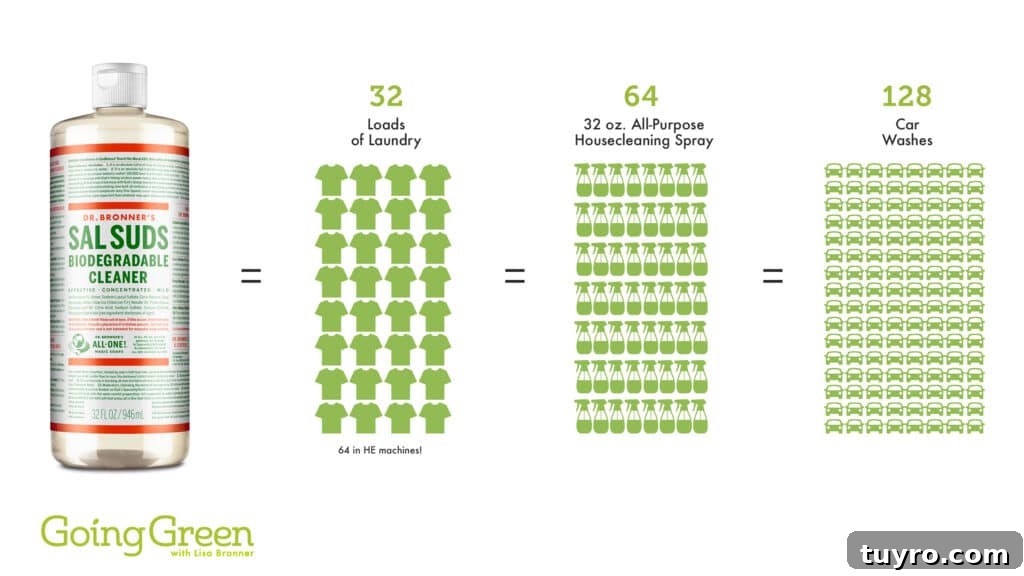
Dr. Bronner’s Sal Suds Biodegradable Cleaner (32 oz.) MSRP*: $14.99 USD
Washes 32–64 loads of laundry
- Use 1–1.5 tbsp (15–22 mL) per load in HE machines; 2–3 tbsp (30–45 mL) in standard machines
- Approximately $0.23 per HE load ($0.47 per regular load)
- Comparable to $0.25 per load for popular “green” detergents and $0.19 per load for common conventional options
Makes 64 bottles of 32 oz. (1 L) all-purpose cleaning spray
- Use 1 tablespoon (15 mL) per 1 quart (1 L) water
- Approximately $0.23 per spray bottle
- Compared to about $1.97 for a store-brand 32 oz. conventional spray
Makes 128 buckets of car-washing solution
- Use 1 teaspoon (5 mL) per gallon (4 L) water
- Approximately $0.12 per wash bucket
- Compared to about $0.04 per wash for the cheapest mass-market car wash concentrate
Baking soda
Baking soda (sodium bicarbonate) is a cleaning staple with odor-absorbing and mild abrasive properties. It freshens refrigerators and carpets, scrubs bathrooms, and boosts laundry performance—especially when combined with Castile Soap or Sal Suds. Buying larger quantities (bags rather than small grocery boxes) cuts cost and increases convenience. Here I reference a 3.5 lb. bag as an accessible size.
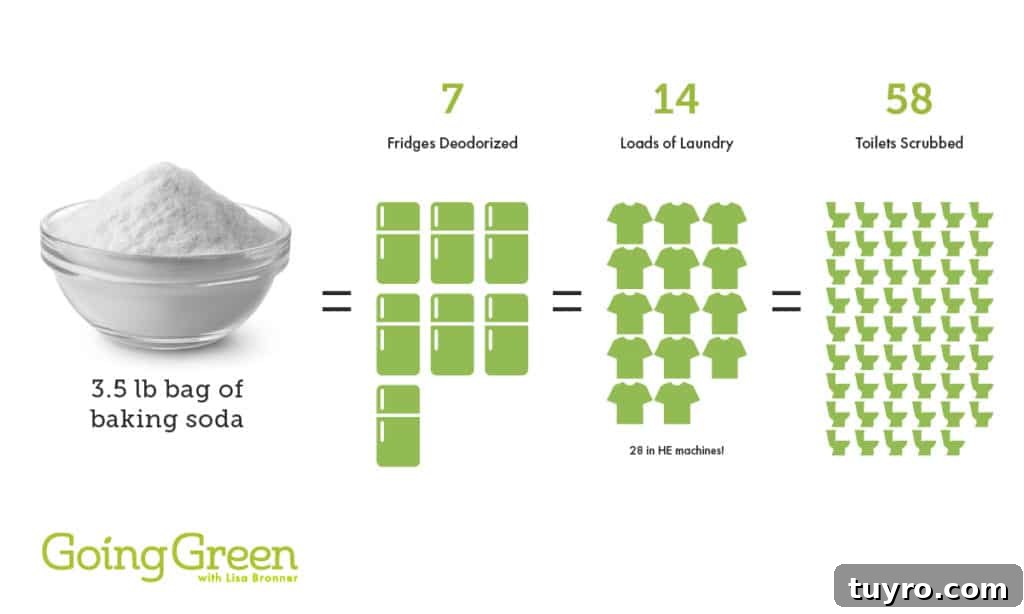
Baking Soda 3.5 lb. MSRP: $3.00 USD
Deodorizes refrigerators
- Place 1 cup (240 mL) in a bowl at the back of the fridge
- About $0.50 per bowl; lasts roughly three months
Boosts laundry
- Add ½ cup (120 mL) to a large regular washer load, or ¼ cup (60 mL) for HE machines
- About $0.21 per regular load, $0.11 per HE load
Scrubs toilets
- Sprinkle 2 tablespoons (30 mL) in the bowl, then spray with an all-purpose cleaner and scrub
- Keep baking soda in a shaker for easy use
- About $0.05 per toilet bowl
Distilled white vinegar
Distilled white vinegar (about 5% acetic acid) is a useful degreaser, descaler, and deodorizer. It works well for glass cleaning, removing soap scum and water spots, and as a laundry booster or fabric softener replacement. Cleaning vinegars with much higher acidity are not more effective for routine uses and can damage delicate surfaces like soft stone.
Important: vinegar should not be mixed with soap. When combined, they react to form fatty acids that create a greasy residue and reduce cleaning effectiveness. Use soaps and vinegar in separate steps. While Sal Suds and vinegar don’t chemically react the same way, vinegar still reduces Sal Suds’ cleaning power, so avoid mixing them for optimal results.
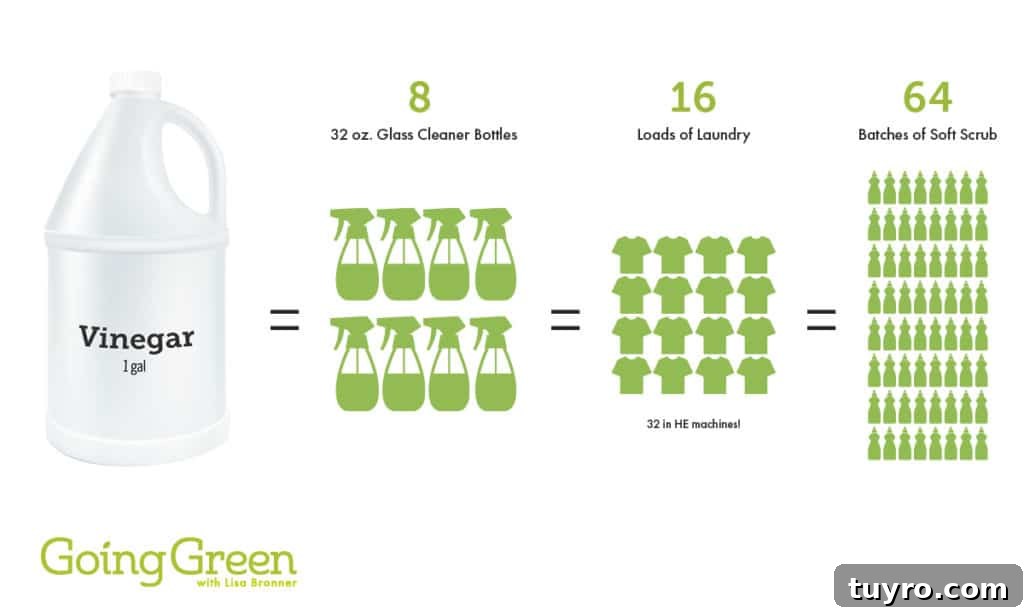
White Distilled Vinegar 1 gallon MSRP: $3.50 USD
Makes 8 bottles of 32 oz. (1 L) glass cleaner
- Combine equal parts vinegar and water
- Approximately $0.44 per 32 oz. spray bottle
- Compared to about $2.08 for a store-brand 32 oz. conventional glass cleaner
Softens laundry when used as a fabric softener
- Use 1 cup (240 mL) in a regular washer, ½ cup (120 mL) for HE machines
- About $0.22 per regular load, $0.11 per HE load
- Compared to about $0.08 per load for a common conventional liquid fabric softener (pricing varies)
Makes soft-scrub batches
- Follow a soft-scrub recipe that pairs baking soda with a diluted vinegar step or a soap-based soft scrub made separately
- Approximately $0.54 of vinegar per batch; total batch cost depends on whether you use Castile or Sal Suds
In summary
These four versatile ingredients replace many single-purpose cleaners, reducing cost, waste, and cabinet clutter. From the examples above, you can replace multiple products with just Castile or Sal Suds, baking soda, and vinegar. That simplicity saves money and makes safer cleaning choices easier—especially important when children and pets are in the home.
My son, now grown taller than I, was unharmed by that 409 episode. But the experience made me reconsider every product I used. Choosing milder, effective green cleaners gives me confidence that the household is safer, and the environmental and financial benefits are an added bonus.
Further reading
- 13 Essential Green Cleaning Ingredients
- Sal Suds or Castile Soap – Which to Use
- With Natural Cleaners Kids Can Clean Too
*Prices mentioned were current as of February 28, 2022. Retailers set final prices; actual pricing may vary.
Sal Suds cleaner shows >60% biodegradation after 28 days per ISO 14593.