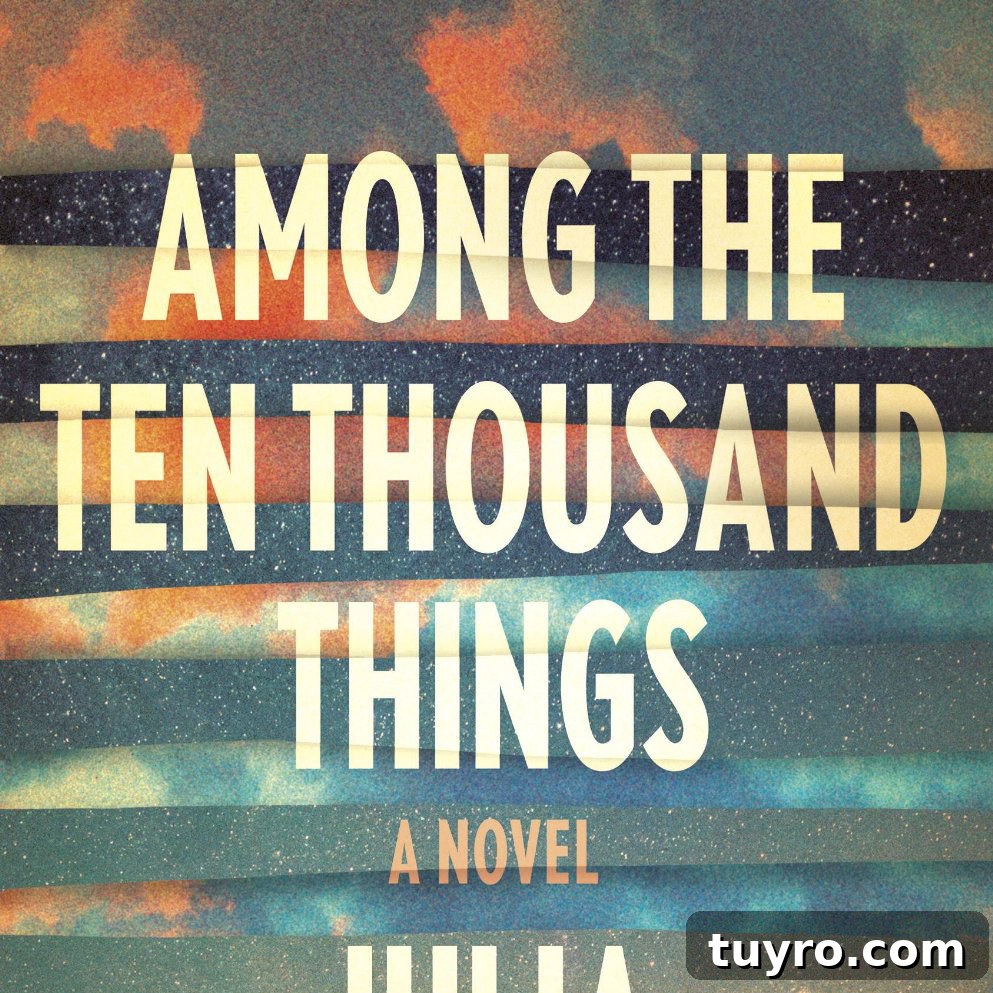
A review of Among the Ten Thousand Things: A Novel by Julia Pierpont. Post may contain affiliate links.
Among the Ten Thousand Things: A Novel opens with a devastating letter addressed to Deborah, the wife of Jack. The letter is not from a friend, a relative, or someone with harmless news. It is from Jack’s girlfriend, the woman he has been sleeping with since the previous June. Along with the letter comes a box, and inside that box is a massive printout of a folder titled “Chats.” The folder contains the private correspondence between Jack and his lover: messages, emails, and conversations that reveal the details of their affair in painful, intimate form.
The premise is immediately gripping because the betrayal is not discovered quietly or privately. It arrives at the family’s door in a physical, unavoidable form. The box is meant for Deborah, but the doorman hands it to Kay, Jack and Deborah’s daughter. Kay opens it, reads enough to understand that something is terribly wrong, and then makes the decision to show it to her brother, Simon. It is a small choice, but it becomes one of the moments that changes the course of the family.
“It was the smallest decision Kay could think to make, smaller even than doing nothing, which felt like deceit. Showing Simon would be like showing herself, because he was theirs too.”
That line captures one of the stronger elements of the novel: the way children are pulled into adult damage even when they are not responsible for it. Kay does not create the betrayal, and Simon does not ask to be part of it, but both of them are forced to absorb the shock of their father’s actions. The affair is not just a private failure between husband and wife. It becomes a family crisis, and each person must decide what to do with the knowledge they now carry.
After Simon sees the notes, he shows them to his mother, and from that point forward the family begins to unravel. The novel follows the emotional aftermath rather than simply focusing on the scandal itself. Deborah must confront the reality of Jack’s infidelity, Kay and Simon must process the collapse of the image they had of their father, and Jack must live with the consequences of what he has done. The story is less about whether the affair happened and more about what happens once everyone knows.
Julia Pierpont’s writing is often sharp and observant, especially when she explores the awkward, painful spaces inside a damaged family. The best parts of the book are the moments that show how differently people respond to the same wound. Some characters retreat, some react, and some try to make sense of events that cannot be neatly explained. The novel does a good job of showing that betrayal rarely affects only two people. It spreads outward, changing the atmosphere of a home and altering the way family members see one another.
However, the structure of Among the Ten Thousand Things can be frustrating. At one point, the author shifts forward into the future, then later returns to the main timeline. This jump feels abrupt and somewhat confusing. It may have been intended to add perspective or show the long-term effect of the family’s breakdown, but for me it interrupted the emotional momentum of the story. Instead of deepening my connection to the characters, it pulled me out of the novel and made me question why the narrative had moved in that direction.
The pacing is also uneven. The opening is strong because the situation is so direct and unsettling, but the story begins to drag in places as it moves through the aftermath. A novel about a family falling apart does not need constant action, but it does need characters who feel compelling enough to carry the quieter sections. While the writing is polished, I sometimes wished I cared more deeply about the people at the center of the book. The idea behind the plot is excellent, but the emotional connection was not always as strong as I wanted it to be.
Overall, Among the Ten Thousand Things is a well-written literary family drama with a striking premise and some memorable observations about marriage, betrayal, and the collateral damage of an affair. Readers who enjoy domestic fiction centered on complicated relationships may appreciate its careful attention to emotional fallout. For me, the novel had a powerful beginning and an interesting concept, but it lost some impact because of the uneven pacing, the confusing shift in time, and characters who remained at a slight distance. It is a thoughtful book, but not one that fully pulled me in the way I hoped it would.